FINE ART EXPERTISES LLC
Most Forged Artists by Category
Why certain names attract forgers — and how collectors get trapped A risk-intelligence report by FAE.LLC Forgery in the art market is not random. Forgers do not target artists because they love them — they target artists because the market structure allows it. High demand, inconsistent documentation, stylistic variability, weak authentication frameworks, and emotional buying environments all create ideal conditions for fraud. At FAE.LLC, we analyze forgery not emotionally, but structurally. Below is a clear breakdown of the most forged artists by category, and why they are so frequently exploited.
I. Old Masters (15th–18th Century) Why Old Masters Are Forged No living artist Workshop systems blur authorship Attribution language is elastic (circle of, follower of, school of) Heavy restorations mask original paint Frequently Forged Names Rembrandt – workshop confusion, endless copies Frans Hals – brushwork imitated, panels altered Van Dyck – studio production mixed with autograph works Caravaggio (followers) – dramatic style easy to emulate Primary risk: attribution inflation rather than outright fake materials. II. 19th-Century Masters Why This Category Is Dangerous Romantic subjects sell easily Academic training allows skilled imitation Canvas, pigments, and supports are easy to source Frequently Forged Names Ivan Aivazovsky – one of the most forged painters worldwide Camille Corot – more fake Corots than authentic ones historically recorded Rosa Bonheur – signatures added later Eugène Boudin – genuine studies with forged signatures Primary risk: genuine period works upgraded by added signatures. III. Modern Masters (1880–1945) Why Forgers Love Modern Art High prices Strong brand recognition Limited but inconsistent documentation Frequently Forged Names Pablo Picasso – drawings, ceramics, late works Amedeo Modigliani – stylistic simplicity exploited Chaïm Soutine – chaotic brushwork hides inconsistencies Fernand Léger – works on paper altered or fabricated Primary risk: stylistic plausibility without historical coherence. IV. Post-War & Contemporary Blue Chips Why Contemporary Art Is Not Safe Certificates replace scholarship Studios outsource production Foundations refuse opinions due to legal risk Frequently Forged Names Jean-Michel Basquiat – fabricated provenance, fake COAs Andy Warhol – prints, signatures, late studio works Mark Rothko – color-field imitations with false histories Jackson Pollock – drip-style deception Primary risk: documentation forgery rather than visual forgery. V. African & Tribal Art Why African Art Is Structurally Fragile Anonymous creators Oral provenance No signatures or dates High-Risk Areas Fang, Kota, Dogon, Baule objects Masks and figures “collected before 1950” without proof Primary risk: aged reproductions accepted as historical works. VI. Works on Paper (Across All Periods) Why Paper Is a Forger’s Favorite Medium Easy to manipulate Difficult to test conclusively Lower buyer resistance High-Risk Artists Picasso (drawings) Matisse (gouaches) Schiele (drawings) Klimt (studies) Primary risk: later additions and fabricated sheets. VII. The Most Dangerous Belief “If it looks right, it must be right.” Forgery succeeds not because buyers are stupid — but because markets reward speed, confidence, and narrative. Final Perspective from FAE.LLC Forged art does not circulate because experts fail. It circulates because: Buyers want certainty Sellers want liquidity Institutions avoid liability Forgery lives in the space between desire and verification. At FAE.LLC, we do not promise certainty — we identify risk before capital is committed. Before You Buy If an artist appears on this list, independent review is not optional. One call before you buy can prevent a permanent mistake. Visit
www.fae.llc
www.FAE.LLC/pricing
www.FAE.LLC/contact LINKS TO SIMILAR SUBJECTS
WHY AUCTION HOUSE DESCRIPTIONS ARE NOT GUARANTEES
https://www.fae.llc/post/why-auction-house-descriptions-are-not-guarantees
WHEN RESTORATION OF A PAINTING HIDES THE TRUTH https://www.fae.llc/post/when-restoration-of-a-painting-hides-the-truth CLIENTS REVIEWS FOR FINE ART EXPERTISES LLC https://www.fae.llc/post/reviews-for-www-fae-llc WHY PERFECT SIGNATURES ARE SUSPICIOUShttps://www.fae.llc/post/why-a-perfect-signature-is-dangerous WHY OLD LABELS MEAN NOTHING IN ART AUTHENTICATION https://www.fae.llc/post/why-old-labels-mean-nothing-in-art-authentication 7 RED FLAGS EVERY COLLECTOR MUST RECOGNIZEhttps://www.fae.llc/post/7-red-flags-in-art-authentication-every-collector-must-recognize WHY FOUNDATIONS REFUSE TO AUTHENTICATEhttps://www.fae.llc/post/why-foundations-refuse-to-authenticate WHY BASQUIAT FORGERY IS A DOCUMENTATION GAME https://www.fae.llc/post/why-basquiat-forgery-is-a-documentation-game MOST FORGED ARTISTS https://www.fae.llc/post/most-forged-artists-by-category WHY AUCTION HOUSE ESTIMATES ARE NOT WHAT YOU THINK https://www.fae.llc/post/why-auction-house-estimates-are-not-what-you-think BUYING DIRECTLY FROM A PRIVATE PARTY https://www.fae.llc/post/buying-art-directly-from-private-collections-or-private-owne HOW TO BUY ART IN AUCTIONS IN EUROPE, USA OR ON EBAY https://www.fae.llc/post/how-to-buy-art-at-auctions-in-europe-the-usa-ebay-a-strategic-guide-for-collectors-and-investor
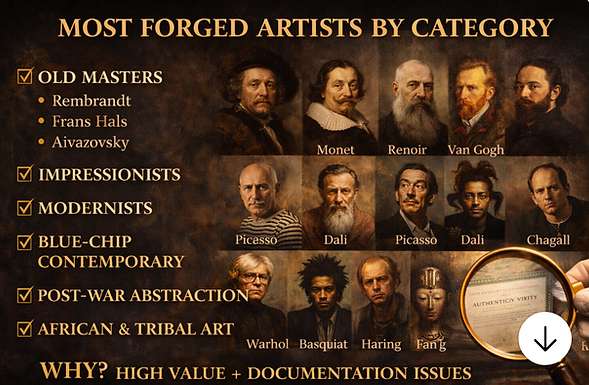
Why certain names attract forgers — and how collectors get trapped A risk-intelligence report by FAE.LLC Forgery in the art market is not random. Forgers do not target artists because they love them — they target artists because the market structure allows it . High demand, inconsistent documentation, stylistic variability, weak authentication frameworks, and emotional buying environments all create ideal conditions for fraud. At FAE.LLC , we analyze forgery not emotionally, but structurally....