Art Investment Without Blind Risk
Why Serious Investors Focus on Evidence, Not Estimates
Art has become an increasingly attractive asset class. But while prices make headlines, risk rarely does.
At FAE.LLC, most of our work begins before a purchase is made—often when an investor is about to commit significant capital based on incomplete or overly optimistic information.
This article explains where art investment risk really lies and how disciplined investors protect themselves.

The Biggest Losses in Art Happen Before the Purchase
Contrary to popular belief, most financial losses in art do not occur at resale.
They occur at acquisition—when a buyer commits to a work that later proves to be:
weakly attributed
over-restored or structurally compromised
supported by fragile provenance
difficult or impossible to resell at the same level
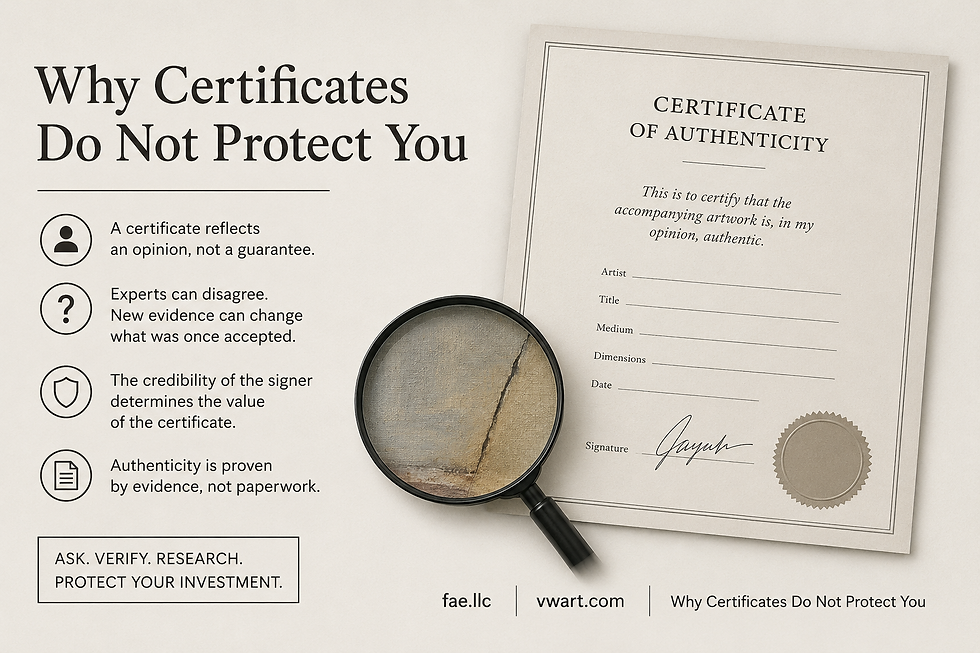
Auction estimates, labels, and certificates often create a false sense of security. In reality, they are opinions, not guarantees.
Why Auction Descriptions Do Not Protect Investors
Auction houses play an important role in the market—but their descriptions are legally framed as opinions.
This means:
An estimate is not a valuation guarantee
Attribution language may be cautious or conditional
Responsibility shifts to the buyer once the hammer falls
Many investors only realize this after a problem emerges.
At FAE.LLC, we analyze what matters most: what the market will actually accept in the future, not what is written in a catalog today.
The Four Structural Risks Every Art Investor Faces
1. Attribution Risk
What matters is not what a work is claimed to be but whether experts, institutions, and future buyers will accept that attribution.
A questionable attribution can severely limit liquidity.
2. Condition Risk
Restoration can improve appearance while quietly destroying value.
Overcleaning, surface manipulation, and structural repairs are among the most common—and costliest—hidden issues.
3. Provenance Risk
A story is not provenance.
We regularly see gaps, inconsistencies, or circular documentation presented as history. These weaknesses often surface later, at the worst possible moment.
4. Exit Risk
An artwork is only an investment if it can be resold.
Liquidity varies dramatically depending on artist, period, condition, and market confidence.
What FAE.LLC Actually Does
FAE.LLC is an independent art advisory and due diligence firm.
We do not sell artworks. We do not represent auction houses. We do not push transactions.
Our role is to help investors understand:
attribution credibility
condition and alteration risk
provenance logic
market acceptance and liquidity
realistic exit scenarios
Our work is designed to support informed decisions, including the decision not to buy.
Our Due-Diligence Method Explained
Every artwork is reviewed through a structured process:
Pre-Screen Review A fast red-flag analysis to determine whether deeper work is justified.
Attribution & Visual Logic Analysis Evaluation of style consistency, materials, signature integration, and surface behavior.
Condition & Alteration Review Identification of restoration, overcleaning, and structural interventions.
Provenance Coherence Assessment Timeline logic, documentation credibility, and historical consistency.
Market Reality Check Comparable results, category acceptance, and resale feasibility.
Decision Conclusion A clearly written recommendation: Proceed / Do Not Proceed / Proceed With Conditions
What Makes Serious Investors Different
Experienced investors understand that
Not every opportunity should be pursued
Speed increases risk
The most valuable decision is often restraint
At FAE.LLC, many successful outcomes are purchases avoided, not deals completed.
Capital preservation is the first rule of art investing.
What FAE.LLC Does Not Promise
To remain transparent and ethical, FAE.LLC does not:
Guarantee future price appreciation
Replace artist foundations or issuing authorities
Provide financial, tax, or legal advice
Promote speculative or trend-driven buying
Our role is to clarify risk, not to sell certainty.
Who This Advisory Is For
FAE.LLC works with:
Private collectors
High-net-worth individuals
Family offices
First-time art investors
Buyers considering auction or private acquisitions
We work with a limited number of clients to maintain quality and discretion.
Final Thought
Art investment rewards discipline, not optimism.
The strongest position in the market is not owning more art—it is owning the right art, for the right reasons, acquired with clear evidence.
FAE.LLC exists to help investors reach that point with confidence.
Interested in learning more?
You may request a private review or investor call directly via www.fae.llc.
Legal Notice
FAE.LLC provides independent advisory opinions and research services only. All opinions reflect information available at the time of review and may evolve if new data emerges. No guarantees of authenticity, market acceptance, or future value are expressed or implied.

Comments