How to Prepare Before Bidding on an Artwork
Updated: Feb 3
A professional guide by FAE.LLC
Buying an artwork at auction is not a game of instinct or excitement. Serious collectors, investors, and institutions prepare before the bid. At FAE.LLC, we regularly see buyers lose significant amounts of money not because they chose the wrong artwork—but because they failed to prepare properly.
This guide explains what to look for, what to verify, and what to avoid before you raise your paddle or click “bid.”

1. Understand What You Are Really Buying
An auction catalogue description is not a guarantee.
Before bidding, you must clearly understand:
What is being sold (original work, workshop, follower, later attribution)
What is assumed versus what is proven
What the auction house legally guarantees—and what it does not
Auction houses sell under strict conditions of sale. These documents almost always protect the auction house, not the buyer.
FAE.LLC principle: Never confuse a catalogue description with authentication.
2. Study the Artist’s Market, Not the Hype
Before bidding, ask yourself:
Is this artist liquid on the secondary market?
Are recent auction results consistent—or erratic?
Does this specific period, medium, or subject matter perform well?
Many buyers overpay because they follow headlines rather than data.
At FAE.LLC, we analyze:
Comparable auction results
Geographic price differences (Europe vs USA vs private sales)
Long-term demand, not short-term trends
3. Examine the Condition—Not Just the Image
Condition issues are one of the most common and costly mistakes.
Always request a condition report, and understand what it actually says:
Restorations (old or recent)
Overpainting and retouching
Structural issues (canvas relining, panel cracks, paper repairs)
Surface cleaning or abrasion
Photographs—especially catalogue images—hide defects.
Red flag: Vague condition reports or phrases such as “in good condition for its age.”
4. Provenance: What Is Known vs What Is Implied
Provenance is often presented in a flattering but ambiguous way.
Look carefully:
Are owners named, or just “European private collection”?
Is there a documented exhibition or publication history?
Are there gaps of several decades?
A short or weak provenance does not automatically mean a fake—but it increases risk.
At FAE.LLC, provenance is analyzed as a risk indicator, not a marketing story.
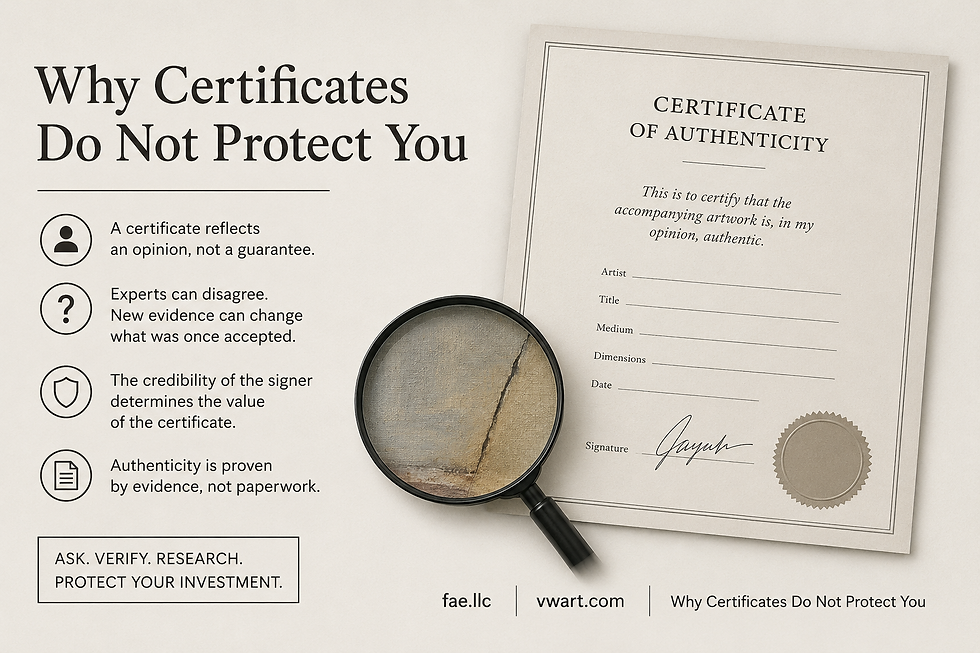
5. Authenticity: The Most Dangerous Assumption
This is where most buyers make their biggest mistake:
“If it’s in a major auction, it must be authentic.”
This is false.
Auction houses do not authenticate in the way buyers assume. Many works are sold:
Without foundation approval
Without catalogue raisonné inclusion
Based on stylistic opinion only
For high-value artists, authenticity should be evaluated before bidding—not after a problem arises.
FAE.LLC does not issue casual opinions. We analyze authenticity as a risk assessment, based on:
Visual logic
Technique and materials
Signature integration
Historical coherence
6. Calculate the True Cost Before You Bid
The hammer price is not the final price.
Always calculate:
Buyer’s premium
VAT or sales tax
Import/export duties
Shipping, insurance, and storage
Many buyers realize after winning that the total cost exceeds market value.
Professional buyers set a maximum all-in price—and never cross it.
7. Emotional Discipline: The Silent Killer
Auction rooms are designed to create urgency and competition.
Common emotional traps:
Bidding wars
Fear of missing out
Ego-driven bidding
Discipline separates collectors from gamblers.
At FAE.LLC, we advise clients to decide before the auction:
Maximum price
Walk-away conditions
Deal-breaker risks
If emotion enters the room, logic must already be locked in.
8. When to Seek Independent Advice
You should seek expert advice when:
The artwork represents a significant financial commitment
The artist is frequently forged or disputed
The provenance is incomplete
You intend to resell or invest
Independent advice means no financial interest in the sale.
This is the core philosophy of FAE.LLC.
Final Thought: Preparation Is the Real Advantage
At auction, everyone sees the same catalogue.
The difference between a smart acquisition and an expensive mistake is preparation.
FAE.LLC exists to protect collectors before they buy—not to repair damage afterward.
Need a Second Opinion Before You Bid?
FAE.LLC offers confidential, independent pre-auction advisory services designed to identify risks, assess authenticity exposure, and protect your capital.
One call before you bid can save you years of regret.
LINKS TO SIMILAR SUBJECTS
WHY AUCTION HOUSE DESCRIPTIONS ARE NOT GUARANTEES
https://www.fae.llc/post/why-auction-house-descriptions-are-not-guarantees
WHEN RESTORATION OF A PAINTING HIDES THE TRUTH https://www.fae.llc/post/when-restoration-of-a-painting-hides-the-truth
CLIENTS REVIEWS FOR FINE ART EXPERTISES LLC https://www.fae.llc/post/reviews-for-www-fae-llc
WHY PERFECT SIGNATURES ARE SUSPICIOUS https://www.fae.llc/post/why-a-perfect-signature-is-dangerous
WHY OLD LABELS MEAN NOTHING IN ART AUTHENTICATION https://www.fae.llc/post/why-old-labels-mean-nothing-in-art-authentication
7 RED FLAGS EVERY COLLECTOR MUST RECOGNIZE https://www.fae.llc/post/7-red-flags-in-art-authentication-every-collector-must-recognize
WHY FOUNDATIONS REFUSE TO AUTHENTICATE https://www.fae.llc/post/why-foundations-refuse-to-authenticate
WHY BASQUIAT FORGERY IS A DOCUMENTATION GAME
MOST FORGED ARTISTS
WHY AUCTION HOUSE ESTIMATES ARE NOT WHAT YOU THINK https://www.fae.llc/post/why-auction-house-estimates-are-not-what-you-think
BUYING DIRECTLY FROM A PRIVATE PARTY
HOW TO BUY ART IN AUCTIONS IN EUROPE, USA OR ON EBAY https://www.fae.llc/post/how-to-buy-art-at-auctions-in-europe-the-usa-ebay-a-strategic-guide-for-collectors-and-investor

Comments